Armored Cable Guide
GYTA33 vs GYTS33: How to Choose Steel Wire Armored Fiber Optic Cable
A buyer-focused comparison of GYTA33 and GYTS33 for demanding buried, water-crossing and mechanically protected routes.
Start with the route, not the model code
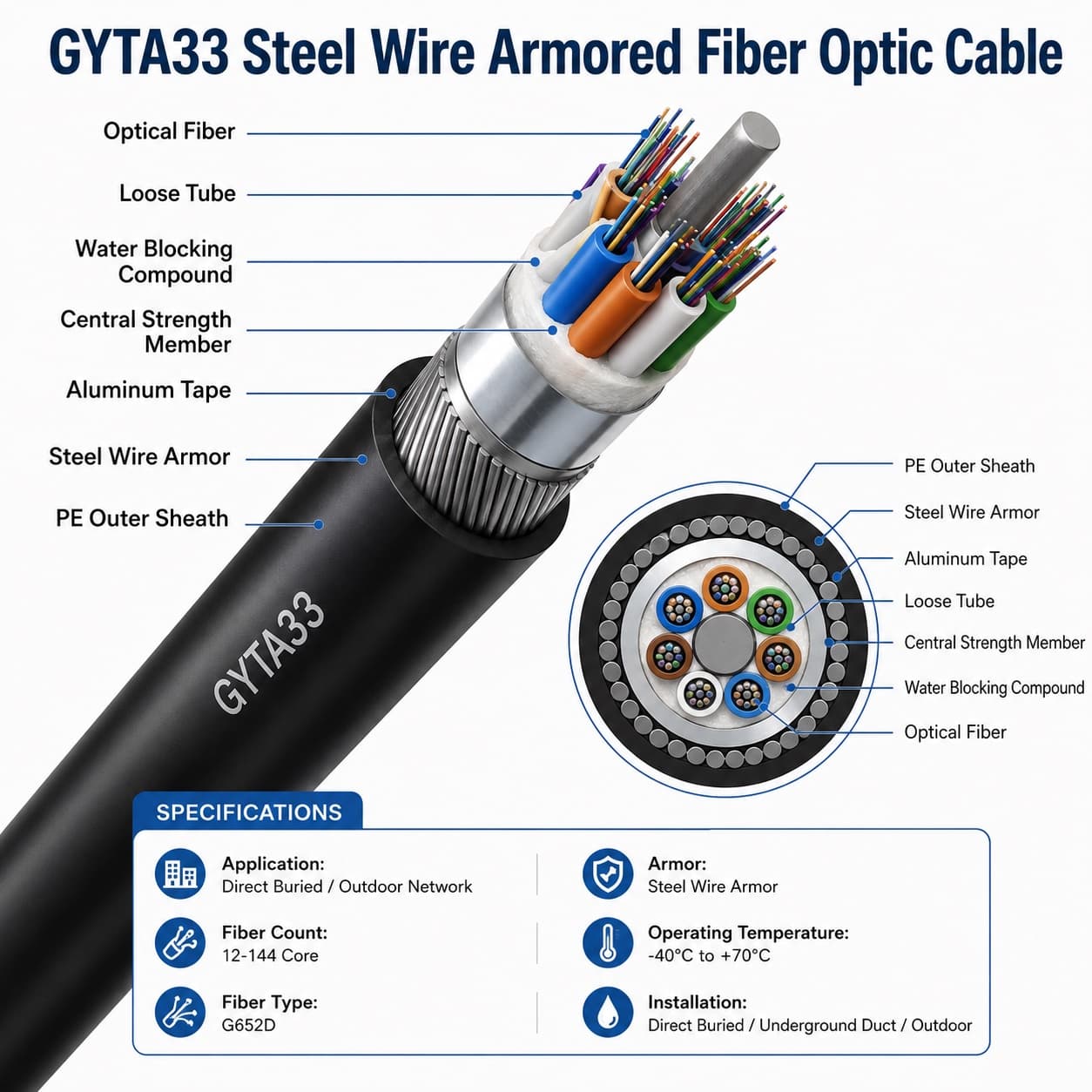
GYTA33 and GYTS33 are both loose-tube cables with steel-wire armour, but the correct choice depends on installation method, water exposure, pulling load, soil condition and the project specification. A model name alone is not enough to approve a cable for direct burial or a water crossing.
The practical structural difference
GYTA33 normally combines an aluminium moisture barrier with an inner sheath, steel-wire armour and an outer sheath. GYTS33 normally uses a steel tape moisture barrier before the steel-wire armour. Because suppliers may use different naming conventions, compare the actual cross-section and bill of materials rather than relying only on the code.
When steel-wire armour is useful
Steel-wire armour is considered where a route needs higher tensile capability, stronger radial protection or additional resistance to difficult handling. It also increases cable diameter, weight and minimum bending requirements, so drums, pulling equipment and installation hardware must be planned around the finished construction.
Do not treat armour as route engineering
Armour does not remove the need to check burial depth, duct condition, water pressure, riverbed movement, corrosion exposure, pulling tension and local installation rules. Submarine or long water-crossing work requires project-specific engineering and acceptance criteria.
Compare quotations on the same fields
Ask every supplier to state fibre type and count, tube arrangement, water-blocking method, tape material, steel-wire size, sheath material and thickness, cable diameter, weight, tensile and crush ratings, bending radius, drum length and test standard. Otherwise two quotations carrying the same model code may describe different products.
Information to send with an RFQ
Provide a route drawing, installation method, longest pulling section, water or soil condition, fibre count, required drum lengths, cable marking, destination and any mandatory IEC, operator or tender requirements. We can then confirm a production structure and the evidence required before shipment.
Need help choosing a product?
Send the route, fiber count, quantity and destination country. Jiaxin Fiber can help match the cable and related FTTH materials.
Request Project Support