Outdoor Cable Guide
GYTA vs GYTS vs GYXTW: Which Outdoor Cable Structure Fits Your Route?
A route-based comparison of GYTA aluminium-tape, GYTS steel-tape and compact GYXTW central-tube outdoor cable structures for duct, aerial and distribution projects.
Start with the route, not the model code
GYTA, GYTS and GYXTW are naming conventions used widely for outdoor optical cables, but the project should approve a construction rather than a label. Define duct, lashed aerial, self-supporting aerial, direct-buried or building-entry use; pulling section; moisture exposure; rodent or impact risk; fibre count; and the governing operator or tender specification. IEC 60794-3 covers outdoor cable families, while the contract sets the construction, performance and tests that apply to the order.
GYTA: stranded loose tubes with an aluminium barrier
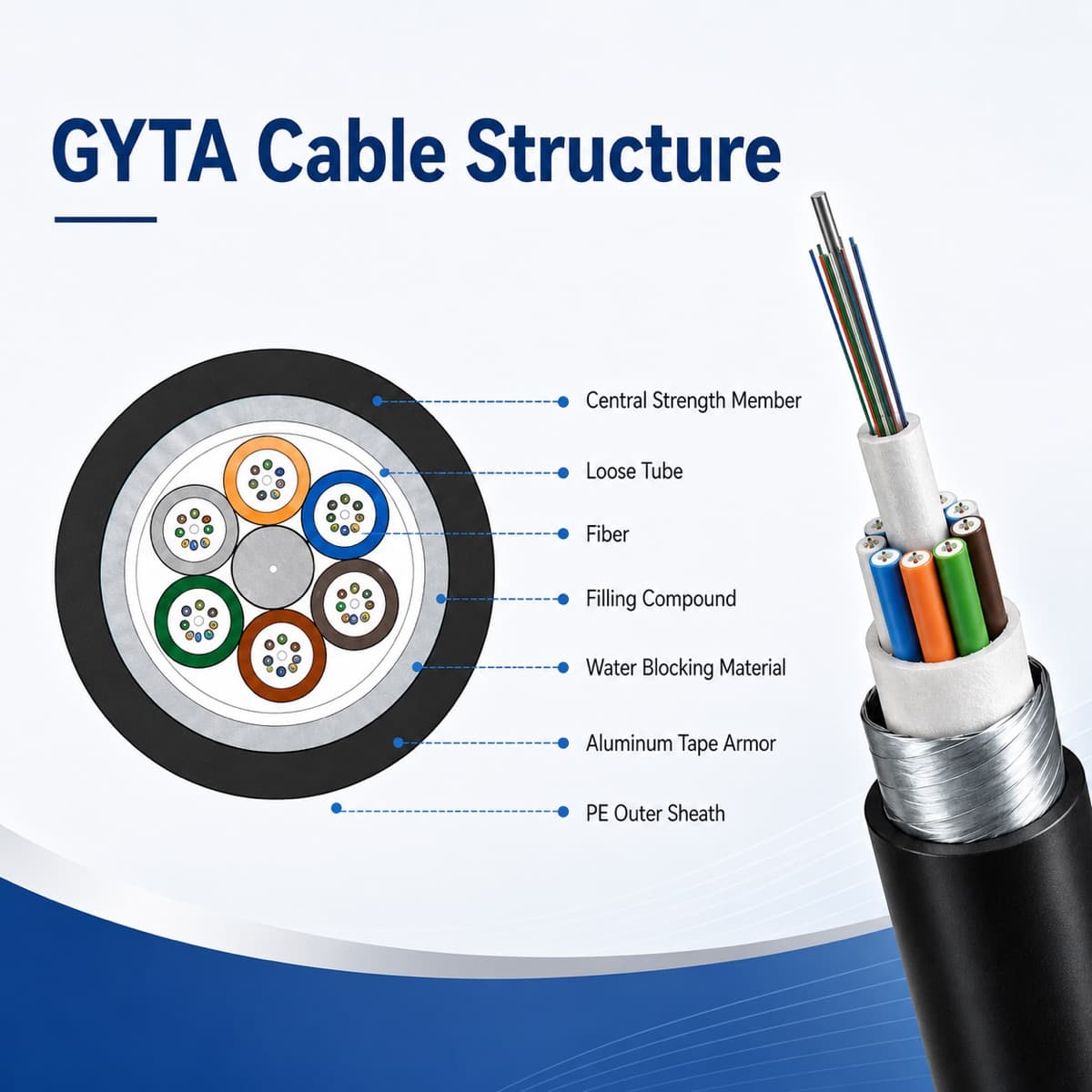
A typical GYTA construction uses multiple loose tubes stranded around a central strength member, water-blocking elements, an aluminium-polyethylene laminate moisture barrier and a polyethylene outer sheath. It can suit duct and general outdoor backbone or distribution routes when the specified mechanical and environmental performance is adequate. The aluminium layer is a moisture barrier and light protection; it should not be presented as proof that the cable is suitable for direct burial or severe rodent exposure without the rest of the construction and route assessment.
GYTS: stranded loose tubes with a steel-tape layer
GYTS typically replaces the aluminium barrier with corrugated steel tape under the outer sheath. The steel layer can provide greater radial and impact protection, but it also changes weight, diameter, bend behaviour, metallic bonding considerations and cost. Buyers should compare the actual tape, overlap, sheath and finished-cable values. Steel tape alone does not make every GYTS construction direct-buried, nor does it remove the need for ducts, route protection or a project-specific anti-rodent strategy.
GYXTW: a compact central loose-tube construction
GYXTW normally places fibres in one central loose tube with water-blocking material, parallel steel wires and a steel-tape barrier under the sheath. Its compact structure can be practical for lower or moderate fibre counts and shorter distribution routes. Because capacity, tube geometry and mechanical design differ from a stranded cable, do not select it only because its outside diameter or price is lower. Confirm fibre count range, tensile and crush requirements, installation method and available drum lengths.
Do not confuse basic outdoor cable with a self-supporting design
Standard GYTA, GYTS and GYXTW constructions may be installed in ducts or lashed to a separate messenger when the project permits, but they are not automatically self-supporting across poles. Aerial routes need a defined support method, span, sag, wind and hardware. If the cable must carry its own aerial load, evaluate an ADSS or figure-8 construction designed for that purpose. If it will be buried directly, assess double-sheath, armour, water blocking and installation protection against the specific soil and mechanical risks.
Compare quotations on one controlled table
Require fibre standard and count, tube count and filling, central strength member, water-blocking method, barrier or armour material, sheath material and thickness, nominal diameter and weight, tensile and crush ratings, minimum bend radius, temperature range, drum length, marking and applicable tests. Suppliers can use different internal designs under the same model name. A line-by-line table exposes those differences and prevents a quotation for a lighter construction from being treated as an equal alternative.
Choose by route risk and lifecycle, not one material
For a protected, clean duct, pulling performance, diameter and duct occupancy may matter more than a steel layer. In shared or damaged ducts, additional radial protection may be valuable. On exposed aerial routes, weight and support method influence hardware and installation. In direct burial, moisture, soil, rodents, digging and repair access must be considered together. The lowest-cost construction at the factory can become the most expensive option if it forces different hardware, more splices or early route repair.
Send the RFQ data that determines the structure
Provide installation method, route length and longest pull, duct size and occupancy, aerial support method if any, soil or water exposure, fibre type and count, required drum lengths, marking, destination, standards and inspection evidence. Add a route sketch or tender section when available. Jiaxin Fiber can then compare GYTA, GYTS and GYXTW against the same conditions and identify any point that requires a different armoured, direct-buried or self-supporting design.
How Jiaxin connects the guide to production
Before production, Jiaxin confirms the actual cross-section rather than relying only on the model code. The order record states armour or moisture barrier, tube count, water-blocking method, sheath, diameter tolerance and drum plan, giving buyers a practical basis for comparing GYXTW, GYTS and GYTA offers.
Need help choosing a product?
Send the route, fiber count, quantity and destination country. Jiaxin Fiber can help match the cable and related FTTH materials.
Request Project Support