OEM · Preconnectorized assemblies
Ordering Preconnectorized Drop Cable: Define Both Ends
Turn connector options and custom lengths into an unambiguous assembly order. Define end A, end B, the length datum, optical acceptance and packing identity for each SKU.
Direct answer: order a defined assembly, not a picture
For an importer or OEM buyer, 'SC drop cable, 100 pieces' leaves major production decisions unresolved. Specify the cable construction, termination at each end, finished-length measurement basis and quantity for every distinct assembly. Then agree the optical acceptance and packing records that will identify those pieces. Jiaxin offers indoor and outdoor preconnectorized drop options; the final configuration and available evidence must be confirmed in the quotation and approved documents.
Name end A and end B independently
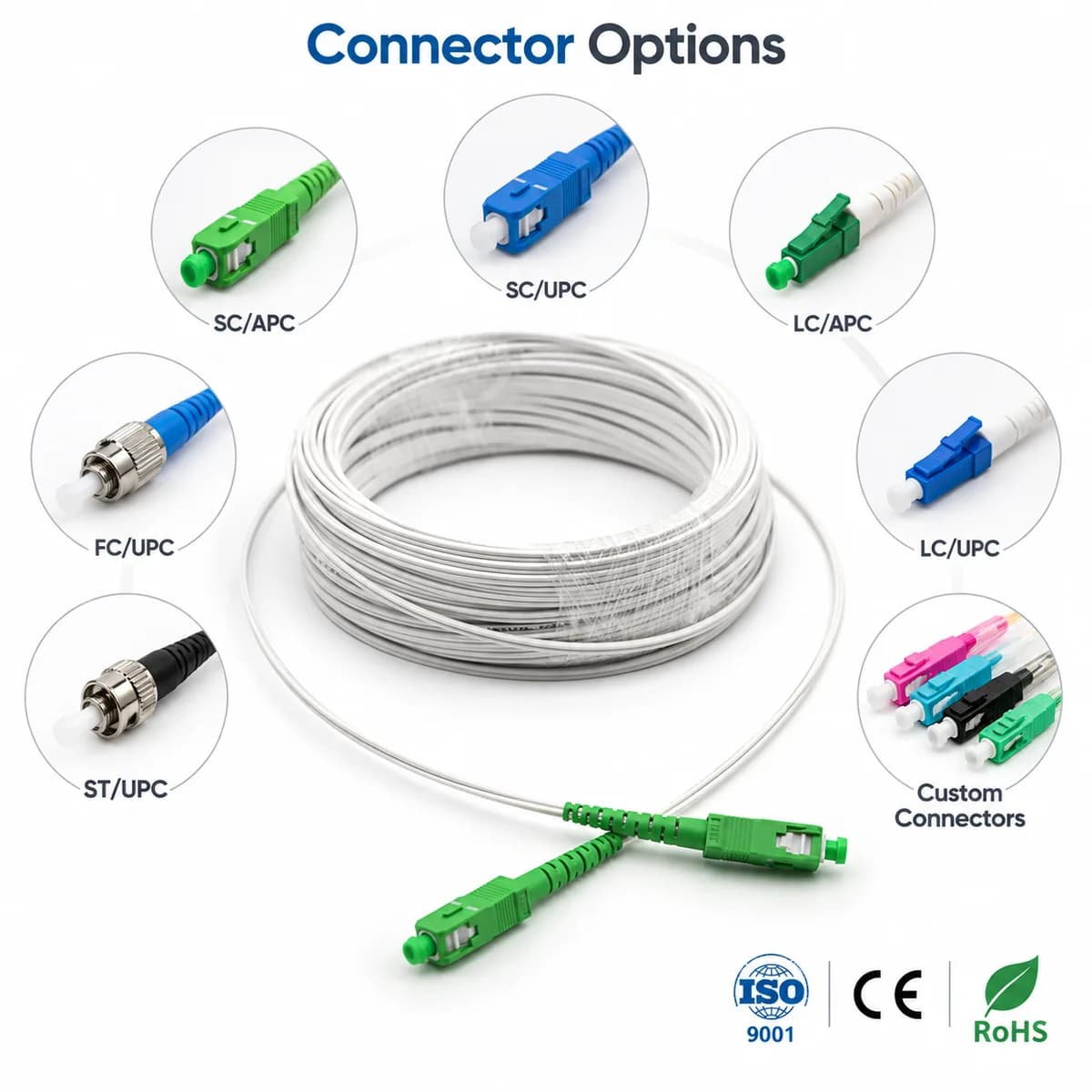
Draw the assembly with a stable A/B orientation. At each end record the connector family, polish, fibre count and mating interface, or state explicitly that the end is unterminated. SC/APC and SC/UPC are not an interchangeable mating pair. A green or blue illustration is not a sufficient purchase specification. If a protected outdoor connection is required, identify the actual terminal interface; an ordinary connector does not become weather-sealed simply because the cable jacket is outdoor-rated.
Specify the construction before choosing length
State fibre type and count, cable dimensions, jacket requirement and installation environment. Indoor and outdoor describe different requirements, not merely white and black cable. Where a building requires a particular fire or smoke classification, provide that requirement and ask for applicable evidence for the quoted construction. Do not infer it from a generic material description or a logo on a product image.
Agree the length datum on the drawing
Define where finished length starts and ends, whether connector bodies or breakout sections are included, and the allowed tolerance. A connector-to-connector datum must be illustrated consistently with the supplier's drawing. For a one-ended assembly, define the terminated reference and the bare-end reference separately. Do not let one bidder price jacket length while another prices overall assembly length under the same line description.
Separate length variants into identifiable order lines
Give each connector pair, cable revision and finished length its own SKU or line reference. As a bookkeeping example, 40 pieces of one length and 60 of another are two controlled lines even when their combined quantity is 100. The example is not a minimum order quantity or stock offer. Record whether approved substitutions are allowed; a longer piece is not automatically an acceptable replacement when the customer's storage space is constrained.
Agree what the optical report actually covers
Specify test method, wavelength, direction where relevant, acceptance limits, sampling or per-piece scope and the required identifiers before production. Insertion loss and return loss are different measurements; a generic 'tested' statement does not define either. FOA's testing guide describes the need for appropriate methods and documented identity. Its guidance does not establish a universal loss limit for every customized Jiaxin assembly. Ask which records are available for the ordered configuration.
Plan protection and identification through receiving
Agree connector protection, coil or bag arrangement, length label, end identification and carton quantities. The outside label should let receiving personnel distinguish similar-looking assemblies without unpacking every item. Confirm whether a pulling protection arrangement is part of supply when required; a dust cap is not a pulling attachment. Retain the approved drawing revision on the packing and inspection records so later replacement orders can refer to the same assembly.
Use a clear production release gate
Release the order only when interface, construction, length, quantities, test scope and artwork have no unresolved conflicts. If a field team later requests a different connector or length, issue a revised line rather than an informal note that bypasses the approved drawing. The supplied cover illustrates connector options, not a single standard assembly. The pictured certification marks do not prove certification or performance of every custom combination; request documents applicable to the actual order.
FAQ: Can the two ends use different connector types?
A mixed-end configuration can be requested, but each end and its intended mating interface must be specified and confirmed. Different end types do not mean incompatible connector faces can be mated together.
FAQ: Is custom length just the number on the label?
No. The number must refer to an agreed measurement datum and tolerance. Put that definition on the approved drawing and use it consistently in inspection and receiving.
FAQ: Does factory testing replace checking after installation?
No. Factory evidence describes the supplied assembly under its agreed test conditions. Handling, cleanliness and the installed link still require the project's acceptance procedure.
Minimum assembly specification
| Order field | Required definition | Do not leave as |
|---|---|---|
| End A / end B | Connector, polish, count, interface or bare end | Same as photo |
| Cable | Fibre, dimensions, jacket and route requirements | Indoor/outdoor by colour only |
| Finished length | Drawing datum, tolerance and quantity per variant | Approximate length |
| Acceptance | Method, wavelength, limits, scope and report identity | Factory tested |
| Packing | SKU, revision, end protection and carton quantities | Standard packing without details |
Release the configuration in six checks
- Confirm the receiving equipment and both mating interfaces.
- Approve the construction for the intended route and building requirements.
- Mark the length datum and tolerance on the drawing.
- Reconcile quantities by unique assembly SKU.
- Agree optical acceptance and the records supplied with the order.
- Approve labels, connector protection and packing against the same revision.
Prepare an order-specific enquiry
Testing background
Make each assembly a quotable line
Send an end-A/end-B drawing, indoor or outdoor route, fibre specification, finished-length definition, quantity by length, acceptance requirements and label artwork. Identify any interface that is not yet confirmed.
Send the Assembly and Quantity Schedule