
Quality control · Re-reeling
Re-Reeled Fiber Cable: Can the Original Test Report Be Used?
When one tested production length becomes several shipping drums, preserve its identity and review the final lengths before accepting a renamed copy of the original report.
Direct answer: retain the original report, but do not simply rename it
For an importer accepting cable that has been cut or re-reeled after testing, the original report can remain historical evidence for the parent production length. It does not, by itself, demonstrate the identity and condition of every final shipping drum. Require a parent-to-child length map and an approved inspection decision for the final pieces. This article addresses that change event, rather than repeating the general list of optical records to request before shipment.
Keep the parent identity when shipping IDs change
Record the original cable ID, construction revision, fibre count, batch and report references before cutting. Give each final drum a unique ID and link it back to the parent. Record who performed the operation, when it occurred, the intended cut boundaries and the final declared lengths. Retain the original files without relabelling them as tests carried out on a later drum. A shipping label is an identity record, not a new measurement.
Reconcile usable lengths, offcuts and the remainder
Use the same declared measurement basis to account for the parent length, child lengths, offcuts and any retained balance. For example, a hypothetical 6,000 m parent recorded as two 2,000 m drums, a 1,980 m drum and 20 m of offcuts reconciles arithmetically. It still requires confirmed identities and acceptance records. The example is not a supplied order or a permitted manufacturing tolerance; never hide an unexplained shortage in a rounding adjustment.
Do not force optical length to equal jacket metre marks
An OTDR reports optical fibre distance using its configured refractive or group index; cable-jacket markings describe a different measurement basis. FOA explains this distinction and the importance of test identification. If numbers differ, the qualified reviewer should check the settings, fibre path and stated measurement method instead of editing a report to match the packing list. Mapping a parent trace to a cut piece requires a known origin and orientation, not just subtraction of two filenames.
Decide what must be checked after the operation
The contractual inspection plan should define the evidence needed after cutting, re-reeling or handling. Ask quality personnel to document the required visual checks and optical verification, including any additional investigation after a suspected kink, impact or damaged end. This guide does not prescribe a universal sample size or acceptance threshold. If the agreed plan requires final-drum tests, a passing parent report cannot waive them; if an alternative evidence route is proposed, obtain the buyer's documented approval.
Record the decision for each child drum
Build a release row containing the child ID, parent interval, declared length, final inspection references, unresolved differences and approval owner. Distinguish a documentation hold from a physical defect and from an accepted, explained measurement difference. Keep affected drums out of the released shipment list until the designated reviewer closes the issue. One accepted child drum should not silently release its siblings.
Update the shipment pack without erasing history
The final label, drum schedule, packing list and current report references should point to the same shipping ID. Retain the old-to-new mapping in the technical file so the recipient can trace an issue later. For a future repeat order, do not reuse this map as proof of the new production batch. Request an order-specific record and agree any native test-file requirements before the reporting deadline.
How to request a Jiaxin review
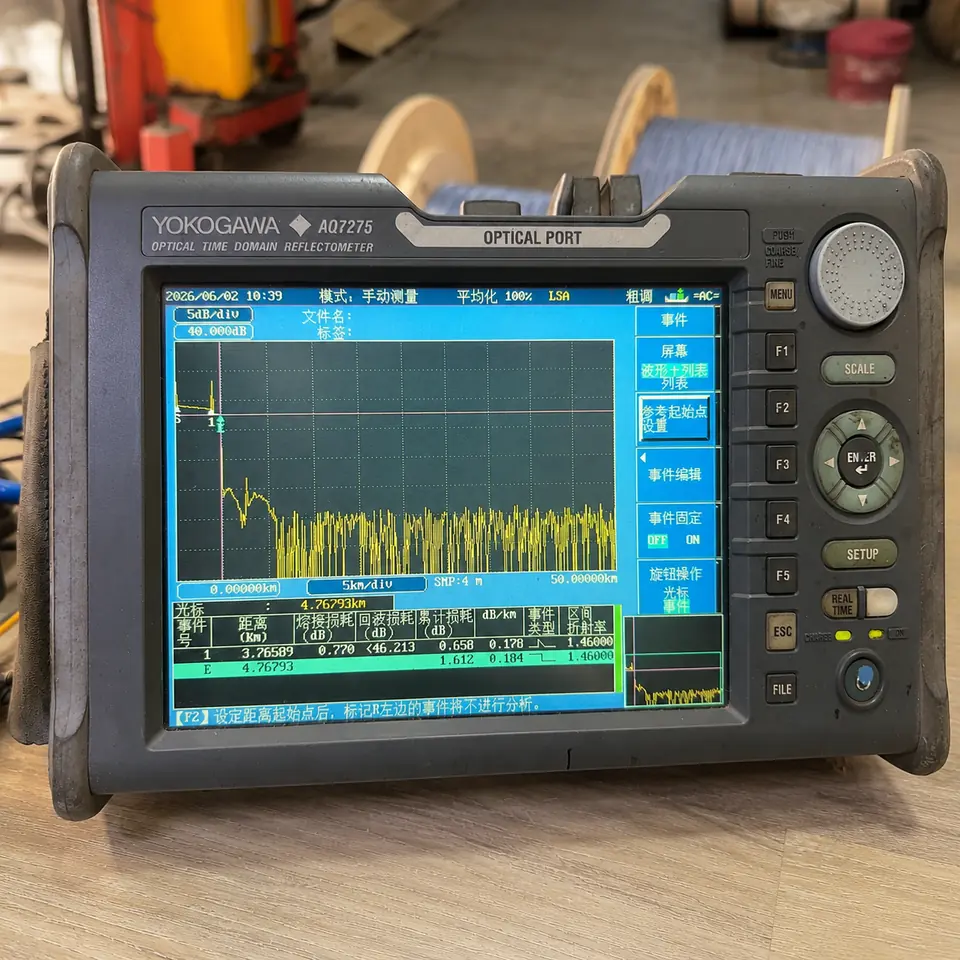
Jiaxin's published supply process includes production identification, inspection and packing coordination. Ask for the proposed final-drum evidence package against your actual purchase specification; availability and test scope must be agreed for the order. The photograph illustrates testing, not the measurements in the numerical example. No picture or general factory certificate substitutes for reconciliation of the final drums being accepted.
FAQ: Does re-reeling automatically invalidate all previous tests?
No. Previous results remain evidence about what was tested at that time. Their relevance to final pieces depends on traceable mapping and the approved post-operation inspection plan.
FAQ: Can we rename the parent PDF for each new drum?
Not as though it were a new test. Keep the original identifier and date, and provide a separate mapping document plus the required final-drum records.
FAQ: Is a small difference between OTDR length and metre marks a defect?
Not enough information. Confirm measurement bases, settings and contractual requirements with the qualified reviewer. Do not invent a tolerance or alter the underlying data to remove the discrepancy.
Final-drum release matrix
| Control | Record | Hold point |
|---|---|---|
| Identity | Parent ID, child ID and construction revision | No reliable link to the tested parent |
| Quantity | Cut boundaries, final lengths, offcuts and remainder | Unexplained balance or inconsistent measurement basis |
| Condition | Post-operation checks required by the inspection plan | Required checks missing or a handling concern unresolved |
| Documentation | Final label, packing line and report cross-reference | Renamed historical data presented as a new test |
Release checklist after cutting or re-reeling
- Preserve original IDs, dates and test files.
- Assign unique final drum IDs and record their parent intervals.
- Reconcile final lengths, offcuts and retained balance.
- Have a qualified reviewer explain measurement differences.
- Complete the agreed post-operation inspection and close deviations.
- Match labels and packing lines to the approved child-drum records.
Prepare the evidence package
Measurement background
Reconcile the final drums before dispatch
Send the original production-length ID, proposed final drum IDs, cut schedule, existing test references and contractual inspection requirements. Identify any handling incident or unverified link in the record.
Send the Parent-to-Child Drum Record