
OEM · Fibre identification
Fibre Colours, Tubes and Ribbons: Specify the Order Map
Turn a request for standard colours into an approved fibre-identification schedule. Connect the cable hierarchy, customer numbering and acceptance records before manufacturing starts.
Make the fibre map part of the approved cable order
For an OEM buyer or project importer, a usable identification requirement describes how to locate every fibre through the cable's tube, ribbon or binder hierarchy. Agree that schedule before production and use the same revision for sample review and acceptance. A note saying 'standard colour code' is incomplete when the customer has not identified the convention or the cable arrangement.
Separate the identification layers
The FOA colour-code reference describes fibre and tube identification and notes that national and customer conventions can differ. In an order, distinguish the individual fibre colour from the tube identifier, ribbon number, repeated-group marking and external jacket legend. A colour may recur in different groups without making the fibres interchangeable. The full hierarchy, not the colour alone, identifies the position. The outer jacket colour also does not establish the internal numbering.
Use one row per traceable position
A practical approval sheet can contain cable reference, tube or subunit ID, ribbon ID where applicable, position within the group, overall fibre number and customer destination reference. Mark fields that do not apply instead of inventing a ribbon layer in a loose-fibre design. Include the drawing revision and an example showing how to read a row. This gives the supplier and the installation team the same starting point without forcing either to infer the other's numbering convention.
Check the boundaries where counting restarts
Illustrative numbering only: if a project defines twelve fibres in each numbered tube, fibre 17 would be position 5 in tube 2. That does not specify its colour, nor does it apply to an arrangement with a different group size. Confirm the first and last positions of every group and any repeated-colour discriminator. These boundary checks are more useful than inspecting only the first few easily recognized fibres in a sample.
For ribbon, agree numbering and the drawing viewpoint
Specify the offered ribbon format, fibres per ribbon and the supplier's identification method. Where the customer uses a drawing to show fibre order, label its viewing direction and reference features so that reversing a sample does not reverse the intended interpretation. Keep the approved ribbon-to-circuit mapping alongside the cable drawing. Do not assume that two products with the same fibre count share the same grouping, ribbon identifiers or preparation method.
Document the transition to an existing network
Ask the buyer for a sanitized mapping of the existing cable and the proposed new cable at the interface. Preserve each cable's own identification rather than renaming fibres informally to make the colours appear to match. The network owner approves which positions are joined; the manufacturer confirms how positions in the supplied cable are identified. This distinction is important when an extension joins a legacy convention to a new factory order.
Approve the sample against the sheet, then retain that revision
Request photographs or sample inspection sufficient to show the agreed hierarchy and repeat markings. Record which positions were checked and which remain outside the inspection scope. A photograph can support a visual check but should not be treated as a calibrated colour reference. Record changes in a revised sheet and confirm whether they affect samples, material already produced or only subsequent batches. Avoid approving production with several conflicting marked-up copies.
Connect identification checks with the release record
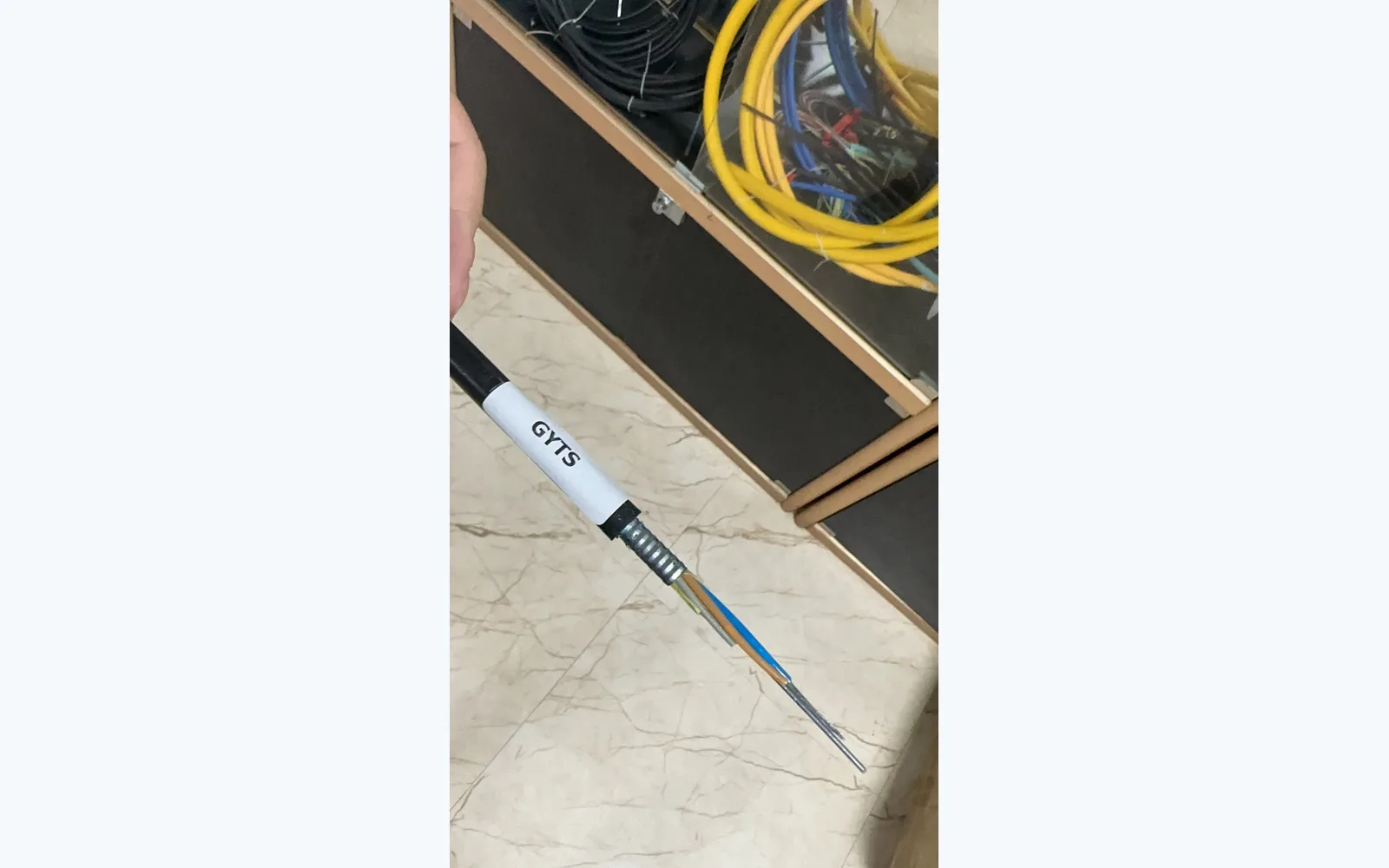
Keep the approved identification schedule with the cable construction and the agreed test-record format. Optical results and visual identification checks answer different questions, so the acceptance plan should specify both where required. Jiaxin can review an OEM identification request alongside quantities, cable construction and delivery requirements; a custom scheme must be confirmed before the order is released. The cover shows a GYTS construction sample with exposed tubes, not a certified colour chart or a ribbon product.
FAQ: Is there one colour sequence for every buyer?
No. Name the required convention and applicable revision, and document customer-specific departures. Do not infer it from the destination country alone.
FAQ: Can a twelve-colour chart identify every fibre in a high-count cable?
Only when combined with the actual grouping and repeat-identification scheme. The same colour may occur in several tubes or ribbons.
FAQ: Does a good optical test prove that numbering is correct?
It does not replace the agreed identification inspection. Ensure that recorded optical results and the supplied fibre map refer to the same traceable positions.
FAQ: What should we send when extending another manufacturer's cable?
Send its verified identification map, the proposed splice correspondence and the new cable requirements. The network owner should approve the correspondence before manufacturing or installation decisions depend on it.
Identification schedule: fields to freeze before production
| Layer | What to specify | Acceptance question |
|---|---|---|
| Individual fibre | Position, colour convention and overall number | Can the inspector locate the specified fibre? |
| Tube or subunit | Identifier, group size and repeated-group marks | Are group boundaries unambiguous? |
| Ribbon where used | Format, ribbon ID, fibre order and drawing viewpoint | Does the supplied layout match the drawing? |
| Network interface | Old-to-new correspondence approved by the owner | Are identifiers preserved on both sides? |
| Release record | Drawing revision, sample findings and inspection scope | Was this exact schedule approved for the batch? |
Six steps from a colour request to a controlled order
- Identify the cable construction and every grouping level.
- Name the colour convention and all customer-specific departures.
- Create a position map and test the numbering at group boundaries.
- Approve any correspondence with the existing network.
- Review the sample against the same controlled drawing.
- Attach the final identification and inspection requirements to the order.
Manufacturing and related procurement guidance
Identification background
Send the identification map, not just a colour request
Provide the cable construction, total fibre count, tube or ribbon layout, required colour convention and edition, customer circuit numbering, drawing revision, inspection requirements and quantities. Mark any transition to existing cable so we can clarify the production schedule before quoting.
Send the Fibre Identification Schedule